
Precisely the same, entirely different
Our Technology: From First Print to Industrial Scale
We have developed cutting-edge technologies to create new-meat that mimics the aroma, mouthfeel and flavour of traditional meat.
Let’s show you how.
It started with a question
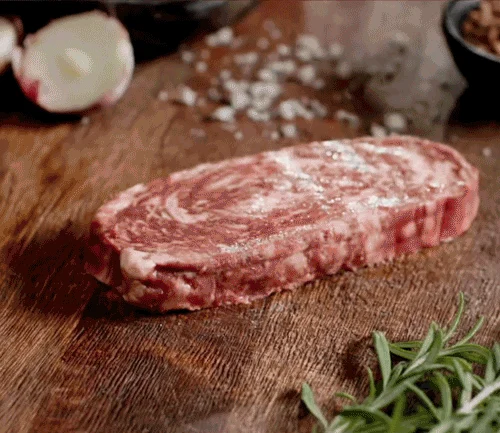
Redefine Meat began with a bold question: could technology recreate the structure and texture of a whole-muscle cut of meat, and create a new category that goes beyond previous generations of plant-based meat?
To answer it, we first had to understand what makes meat, meat. Almost all the meat we eat is animal muscle, and muscle may be the most complex food there is. Its structure is shaped by the animal’s biology and movement, and that complexity shows up everywhere: in the raw cut, in how it changes as it cooks, and in what happens when we bite into it.
Minced products like burgers and sausages break that structure down. Muscle turns into mass, and everything averages out. A steak can’t be simplified that way. Stiffness, fibre structure, cohesiveness, colour gradient, how it reacts to heat, smell and flavour all have to work together, along with many qualities we feel but can’t easily put into words. That’s why whole cuts had stayed almost untouched by the plant-based industry. To make them, we had to take on that complexity rather than avoid it.
The first breakthrough: printing a steak
Our first answer came from 3D printing. Building layer by layer, additive manufacturing can create complex structures that traditional food processes can’t.
We developed a multi-material food printer designed specifically for New-meat. It laid down protein, fat and “blood” at the same time, placing each one exactly where it belongs according to a digital structure modelled on animal muscle. Ingredients could also be combined during printing to create new materials that matched a specific cut. The result proved that steaks and other whole cuts could be made from plants, with the texture, bite and mouthfeel of animal meat and without harming any animal.
Print, sample, repeat
The printer also changed how fast we could develop products. In traditional plant-based production, changing a product’s structure can mean reconfiguring heavy machinery, which takes days or weeks, costs a lot and relies heavily on trial and error.
With digital production, we could adjust a product’s structure in software within minutes, print several versions and compare them almost immediately. By changing the digital file, the same system could produce different meats and cuts. This rapid prototyping let us learn and improve at a pace traditional methods couldn’t match.
From the development kitchen to the plate
Proving the concept was the first milestone. Next came a limited launch of steaks made directly on our semi-industrial printers, which showed that chefs and diners wanted what we were making.
But producing one product at a time on a small additive manufacturing device is slow and expensive. It can prove the product and the demand, but it can’t supply restaurants and retailers around the world at a competitive price. New-meat will only become part of everyday eating when it can be made in large volumes, with consistent quality and at a competitive cost. We call this true parity, and for our industry it is the challenge that matters most.
Today: additive manufacturing at industrial scale
So we took everything we had learned from years of printing, culinary development, launch and our first years of commercial production, and engineered something new: a continuous, end-to-end production line built on our Meat Matrix Additive Manufacturing (MMAM) technology.
Like the printers in our development kitchen, the line uses additive manufacturing, building New-meat layer by layer to recreate the texture, bite and juiciness of animal meat. Unlike a 3D printer, it is fast, automated and built for industrial scale, producing tens of tons every month.
From a single printed steak to a production line, our goal has stayed the same: New-meat that’s as delicious, culinarily versatile and satisfying as meat from an animal, made at a scale that can change what the world eats.
Work with us
Samples, pricing and distribution. Talk to our foodservice team.
 Vanessa