
Environment
Making a positive impact
From extreme greenhouse gas emissions to excessive land and water usage, beef production has a significant impact on the environment. At Redefine Meat, we are proud to be working on real ways to change this and make it easier for everyone to enjoy great food without compromise.
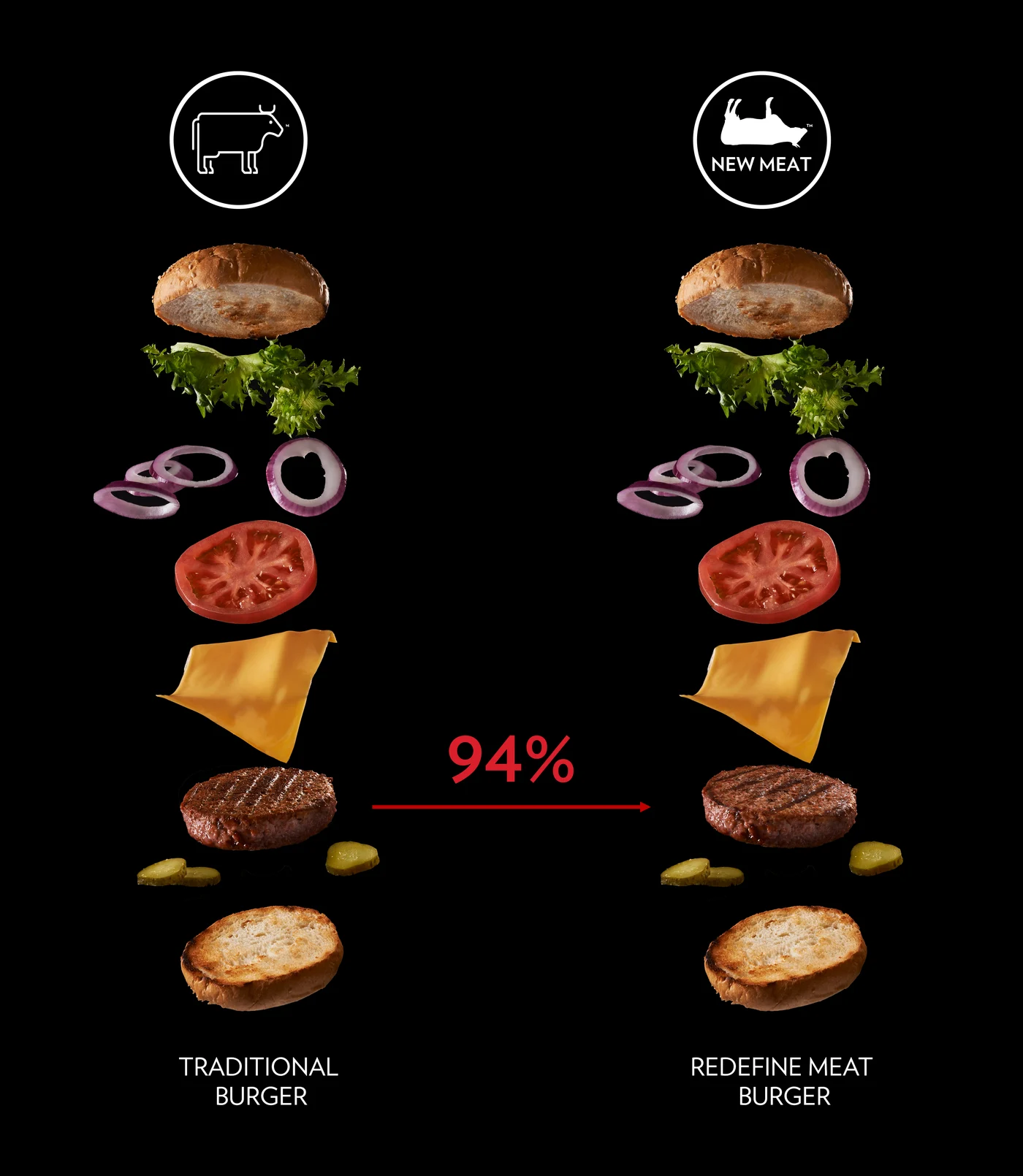
See three ways in which new-meat can create a more sustainable future.
Water consumption
Over two-thirds of our planet is made up of water and yet freshwater remains a precious resource in scarce quantities, as a consequence of pollution, droughts and floods. Freshwater supplies are already affected on a global scale and the beef industry is one of the top three contributors to this problem.
New-meat production is twenty times more efficient and uses 96% less water per kilogram than a beef hamburger.¹ If every family in each OECD country replaced one meal per month of traditional meat with Redefine Meat™,² the water saved would be the equivalent of the annual drinking water of China and India combined. Making this change once a week would save the equivalent of an entire year's worth of drinking water for the entire global population.
- Based on initial results of Life Cycle Analysis (LCA)
- Redefine Meat's Flank
Land use
The world is producing four times more meat today than it did 50 years ago. In fact, 60% of the world's agricultural land is used for beef production. New-meat production requires 98% less land — a significant environmental benefit.
In developed countries, if each family replaced one meal of beef with Redefine Meat each week, it would free an area equivalent to 1.5 times the size of Spain, or 13% of the Amazon Rainforest.
- Our World in Data, Meat and Dairy Production
- Globalagriculture.org, Agriculture at a crossroads
Greenhouse gas emissions
Meat production has a significant impact on the climate crisis. Human activities are responsible for almost all greenhouse gas increases in the atmosphere since the late 1800s, with beef production being among the most polluting industries.¹ World leaders have committed to reducing emissions by 30% by 2030.
The production of one kilogram of Redefine Meat emits the equivalent of 1/9 of the greenhouse gas emissions required to produce a kilogram of beef burger. If every family in the OECD countries replaced one meal of beef per week with Redefine Meat, the reduction in emissions would be equivalent to removing 86 million family-sized cars from circulation.
- Taylor & Francis Online, A general view to converting fossil fuels to a cleaner energy source by adding nanoparticles
Work with us
Samples, pricing and distribution. Talk to our foodservice team.
 Vanessa